What Are AGM and Gel Batteries?
Two maintenance-free sealed lead-acid battery families — the answer to ‘which one?’ lies in the usage profile.
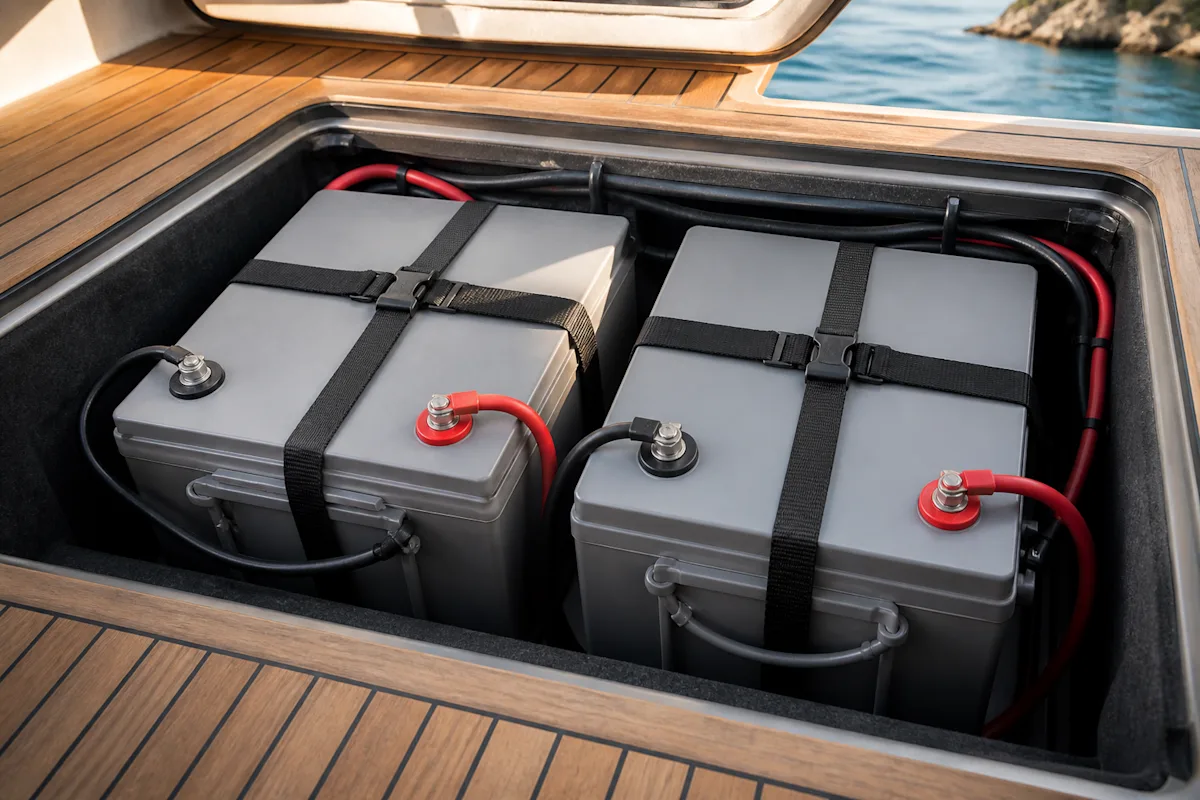
Choosing a boat battery is confusing because there are four different families doing much the same job, and each has its own price, life and maintenance requirements. AGM and gel sit in the middle ground between a conventional flooded battery and expensive lithium: both are sealed, need no topping up, can be mounted on their side and cope well with vibration.
The right choice is not in the brand, it is in your usage profile. How deeply will your bank be discharged, and which charging sources do you have — alternator, charger, solar — and what profiles do they support? The table below puts the four families side by side.
Battery types comparison
Feature | Flooded (lead-acid) | AGM | Gel | Lithium (LiFePO4) |
|---|---|---|---|---|
Maintenance | Requires topping up with water | Maintenance-free | Maintenance-free | Maintenance-free |
Usable capacity | ~50% | ~50% | ~50% | ~80-90% |
Charge acceptance | Slow | Fast | Moderate, sensitive | Very fast |
Life (approx. cycles) | 300-500 | 400-700 | 500-1000 | 2000-5000 |
Weight | Heavy | Heavy | Heavy | Light |
Price | Low | Medium | Medium-high | High |
Ideal use | Starting, tight budget | Starting and general service | Deep, slow cycling | Intensive liveaboard use, weight-sensitive boat |
The most critical line in the table is usable capacity. In the lead-acid family, the practical limit for life is 50% discharge; in other words, the truly usable daily portion of a 200 amp-hour bank is about 100 amp-hours. That is where the technical value of the lithium price difference really shows: from the same nameplate rating, it will deliver almost twice the usable work.
Before deciding, ask two questions
How deeply will my bank work? If it is being discharged often and deeply, lithium’s long life can pay back its higher price.
Are my charging sources suitable? When moving to lithium, alternator protection — a DC-DC charger or an external regulator — is not optional, it is essential.
Whatever the type, one thing never changes: voltage readings are only an estimate, a battery monitor tells you the truth. A sound battery-bank decision starts with measurement.