What Are Amp-Hours (Ah) and Battery Capacity?
The unit used to measure a battery’s energy store - knowing that only half the number on the label is truly usable is the first step in energy planning.
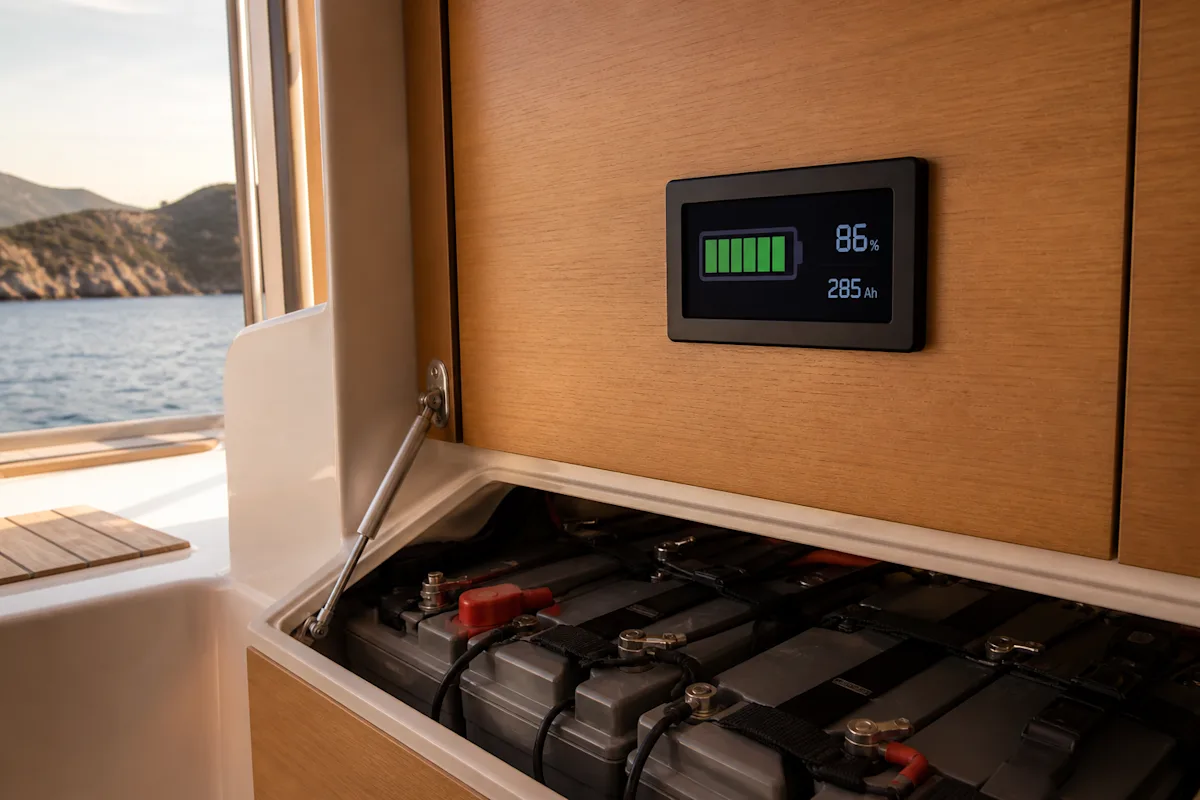
Amp-hours (Ah) are the unit used to measure a battery’s energy store: a 100 Ah battery can roughly deliver 5 amps for 20 hours. A boat’s energy budget is written in the same language, so you add up the amps drawn by each device and work out the daily demand.
The table below shows roughly how much current typical equipment draws. The figures are approximate and vary by model, but they are enough to get started with your budget calculation.
Typical equipment consumption (12V)
Item | Approx. draw | Notes |
|---|---|---|
Fridge (compressor) | 3-4 A average | The biggest item in the daily budget |
LED lighting | 0,5-2 A | Cabin-wide |
Autopilot | 2-5 A | Depends on sea state |
Navigation (plotter, VHF) | 1-2 A | Always on |
Water pressure pump | Intermittent, high peak | Only when the tap is running |
Inverter (standby) | Amps per hour | If left on, it will flatten the battery |
The most important fact is usable capacity: for lead-acid batteries (flooded, AGM, gel), the practical limit for long life is 50% discharge. So the daily usable portion of a 200 Ah battery bank is about 100 Ah. Most complaints of 'my batteries are new but they always go flat' come down to the label speaking a different language from expectations.
Half an hour’s homework sorts out a lot: calculate your daily Ah budget device by device, compare it with half the bank’s usable capacity, and close the gap either with more generation (solar) or more capacity. Once the numbers are doing the talking, battery arguments on board stop.