What Is a Battery Charger (Marine Charger)?
The smart unit that turns shore power into the language of your batteries - responsible for keeping them alive through lay-up and bringing them up quickly in summer.
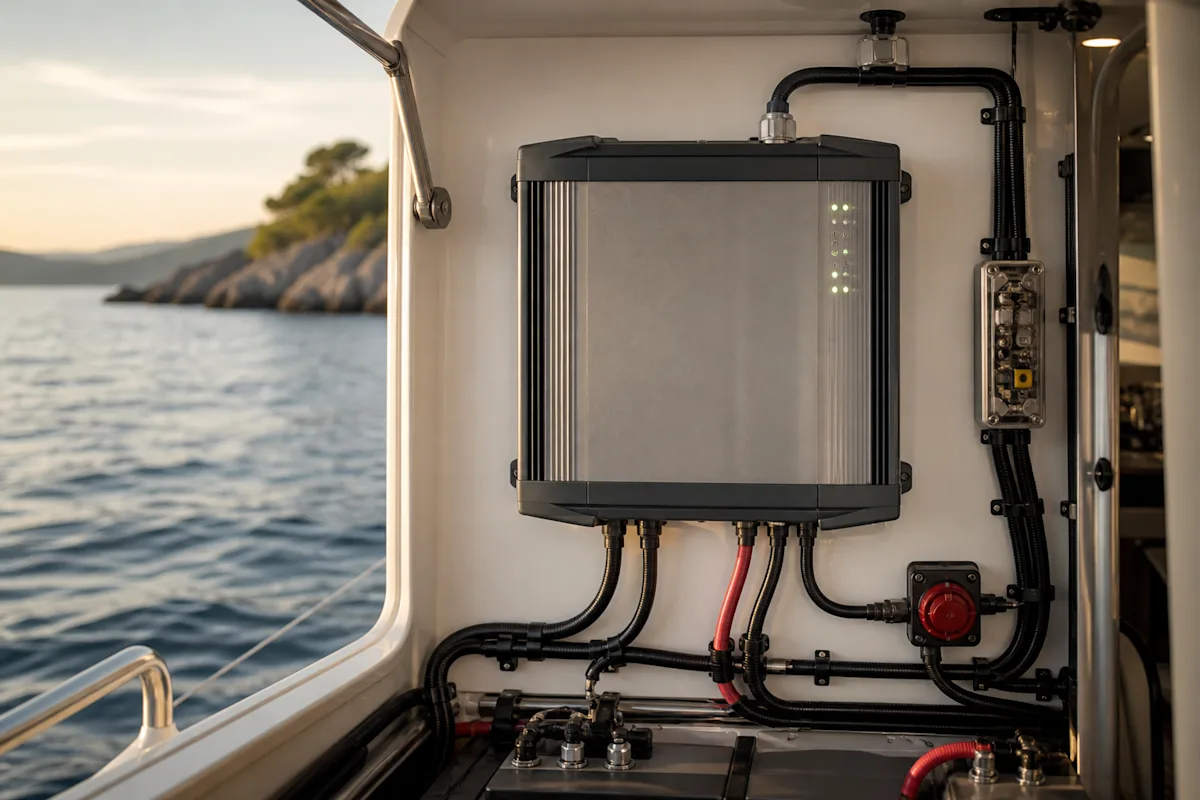
A marine charger takes 220V shore power and charges the batteries in stages (bulk: full current, absorption: constant voltage, float: protection). A good marine charger has multiple outputs, can be set to suit the battery type, and uses a temperature sensor to correct the voltage.
It is the most important piece of kit on a boat in lay-up: in float mode, batteries left for months stay healthy. Batteries left over winter without a charger - or only on a basic transformer charger - either run flat or get boiled dry.
Selection and installation
Size: As a rough rule, allow charging current of 10-20% of bank capacity (40-80 A for a 400 Ah bank); a smaller charger is not bad, just slower.
Right type: Using a flooded profile on a gel battery, or a lead-acid profile on lithium, quietly shortens the battery's life; the charger settings must match the battery type.
Ventilation: A charger suffocating in a hot locker cuts its output; people think 'the charger is too small', when in fact it cannot breathe.
The three questions for lay-up are: is the charger in float, is the battery type set correctly, and are the terminals clean? When fitting a new battery bank, the charger's type and capacity should be considered in the same project; testing a battery investment with an old charger is a common and needless false economy.