What Is Marine Cable and Wire Size?
Tinned-copper, multi-strand specialist cable — the unseen quality behind boat electrics and the subject of voltage-drop calculations.
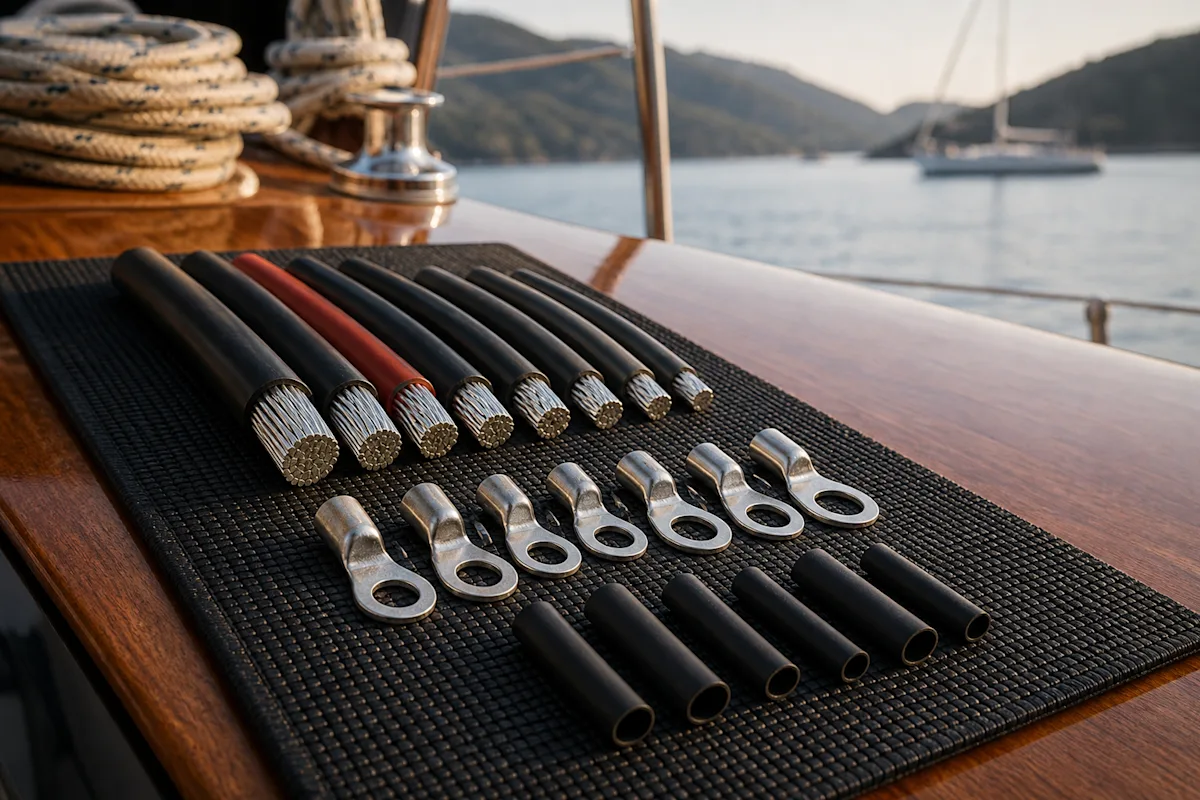
Marine cable is cable made for the marine environment, and an installation done with house or automotive cable may work for the first few years, then turn green and rot away. At sea, cable failure comes from corrosion creeping through the strands by capillary action, and you won't see it.
The table below shows what sets marine cable apart from ordinary cable.
Marine cable - ordinary cable
Feature | House/auto cable | Marine cable |
|---|---|---|
Conductor | Bare copper, oxidises | Tinned copper, corrosion-resistant |
Construction | Few strands, stiff | Many strands, flexible, vibration-resistant |
Sheath | Standard | Oil- and UV-resistant |
On the sizing side, physics is ruthless: a windlass fed with undersized cable looks 'weak', a fridge 'faulty', a heater 'temperamental'; in all three cases the real issue is voltage drop. Size is chosen not by 'it works' but by calculation: current plus return run plus a 3% drop target for critical equipment.
The buying rule is simple: cable without 'tinned' or 'marine grade' on the label does not go on board. Every feed taken directly from the battery must be fused as close to the battery terminal as possible; an unfused cable is a wick for fire. And label every new run — you'll thank yourself in five years.