What Is an MPPT Charge Controller?
A smart controller that converts a solar panel’s output into battery-friendly power — the difference that can squeeze noticeably more amps from the same panel.
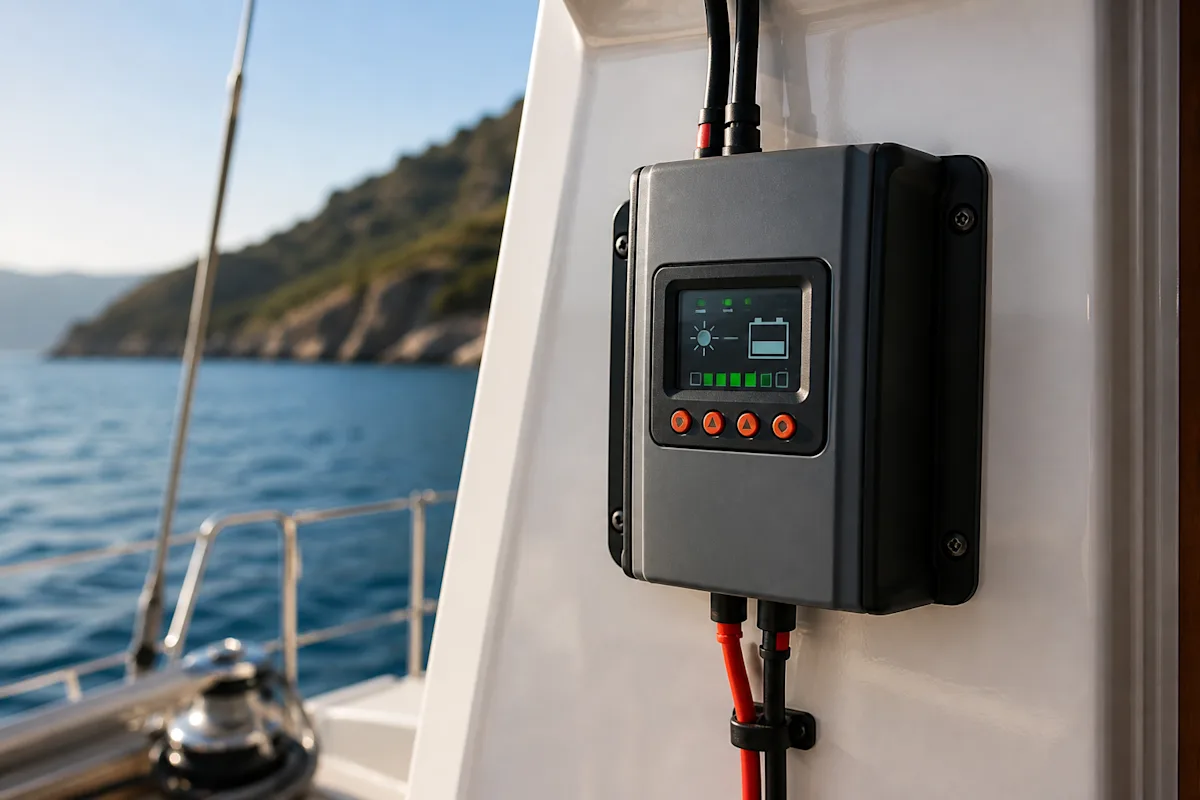
MPPT is a smart solar charge controller that converts the power produced by the panel into the most efficient form for the battery. It continuously tracks the panel’s most efficient operating voltage for the current light conditions, then converts and feeds that power to battery voltage. The simpler PWM alternative drags the panel down to battery voltage directly and wastes the difference.
On a boat, panel space is limited, so squeezing more amps from the same panel matters. The table below compares the two controllers.
MPPT - PWM comparison
Feature | PWM | MPPT |
|---|---|---|
Efficiency | Low, it wastes the voltage difference | High, it converts panel power |
Gain | Baseline | Roughly 15-30% more energy |
When the difference shows | - | In cool or partly cloudy conditions, when panel voltage is high |
Price | Cheap | More expensive, but often the equivalent of adding another panel |
Even in a small system, the benefit of MPPT is noticeable. But cable size and connection quality come first: even the best controller cannot recover voltage lost through a poor crimp or loose termination. It is also essential to set the correct battery type on the controller (AGM, gel, lithium), otherwise the batteries will be undercharged or overcharged.
The daily amp-hours shown on the controller display are the system’s health report; check it once a week. Do not forget shade management either: MPPT is not a miracle cure, and panel placement still comes first.