What Are Nautical Miles and Knots?
The sea has its own kilometre and its own clock - a system of measurement that combines chart work with maths, which is why it never retires.
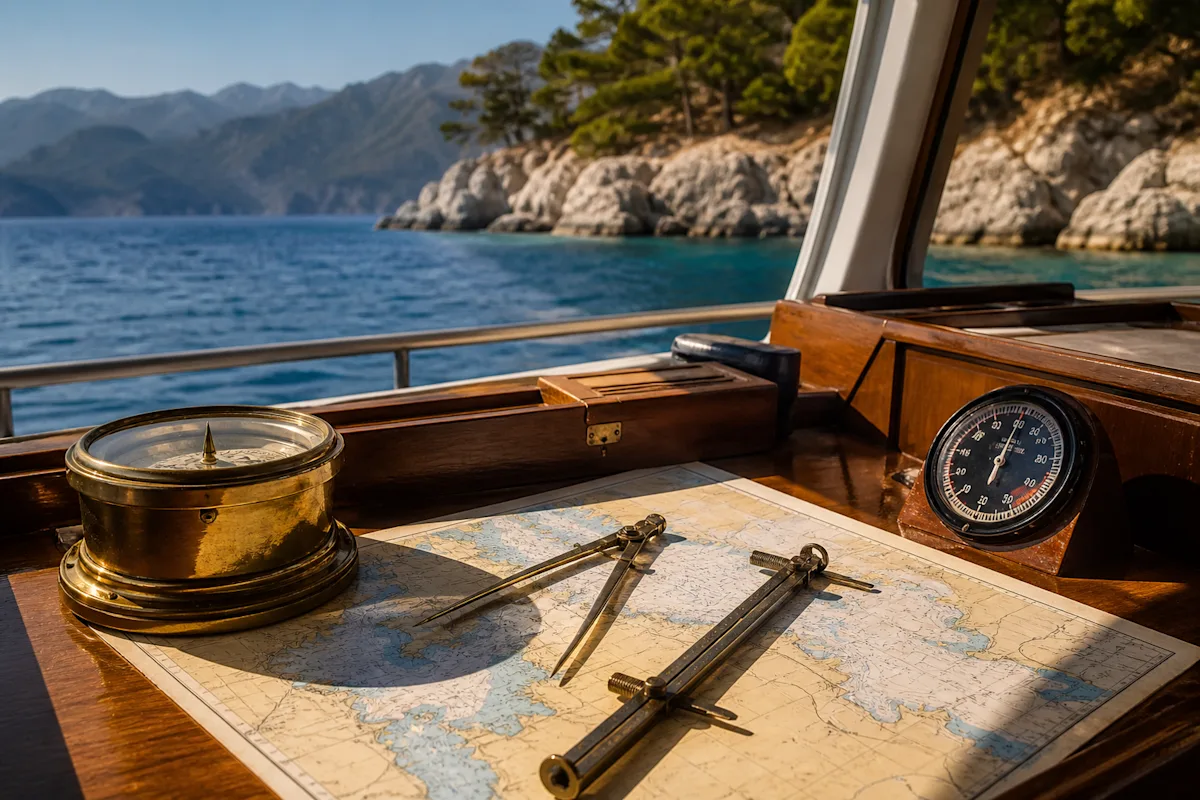
The sea has its own kilometre and its own clock.Nautical mileis 1852 metres and was not chosen at random: it is the length of one minute of latitude on the Earth.Knotmeans one nautical mile per hour, so it is already a speed unit; you do not say 'knot/hour'.
Why is this pair still used? Because it locks the chart and the calculation together. On the chart, every minute of latitude along the edge is exactly 1 mile, so you can read distance directly with dividers from the edge. With speed in knots and distance in miles, passage planning can be done in your head: 6 knots over 18 miles takes 3 hours.
Knot - km/h conversion table
Knot | km/h (approx.) | Everyday equivalent |
|---|---|---|
5 kn | 9 km/h | Above walking pace, easy cruising |
6 kn | 11 km/h | Typical sailing yacht cruising speed |
8 kn | 15 km/h | Comfortable cruising for a displacement boat |
10 kn | 18.5 km/h | Fast motor cruiser, economical band |
20 kn | 37 km/h | Planing speed for a powerboat |
A handy pocket rule for converting: double the knot value and knock off about 10%, and you will have km/h (10 knots is 18.5).
Time and distance calculation
When working out arrival time, the rule is simple: distance (miles) divided by speed (knots) gives time (hours). The table below gives a few examples at 6 knots:
Distance | Speed | Time |
|---|---|---|
6 miles | 6 kn | 1 hour |
18 miles | 6 kn | 3 hours |
30 miles | 6 kn | 5 hours |
For fuel planning, the golden unit is litres per mile, not litres per hour; the same engine at different revs will produce a very different number of miles. Wind, sea and current will change these figures, so plan for the worst day, not the best one.