What Is an Impeller?
The flexible rubber impeller in the seawater pump - the smallest but most critical link in the engine cooling chain.
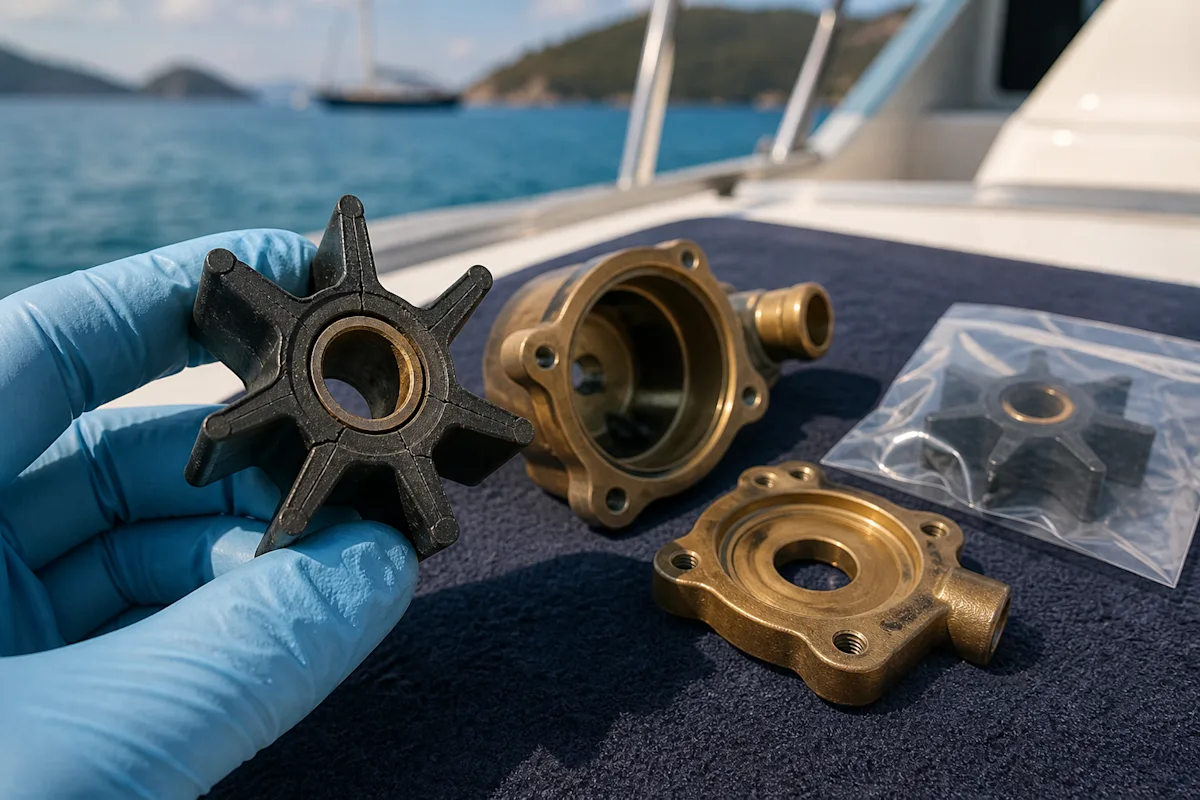
An impeller is the flexible rubber rotor with vanes that turns inside the seawater pump. It draws in seawater and forces it through the system so the engine can stay cool; its flexible vanes rub against the pump housing as it works, so by design it is a wearing part. It is small, but it is the first link in the cooling chain: if the impeller does not pump water, the engine will overheat within minutes.
Worse still, if a vane breaks off, it can travel into the cooling passages and that tiny bit of rubber can turn into a major overheating fault through a blocked heat exchanger. That is why the impeller is not something you change only when it fails, but one you replace when its time is due.
Symptoms, causes and first checks
Symptom | Possible cause | First check |
|---|---|---|
Water at the exhaust has reduced / stopped | Burnt out or tired impeller | Is the seawater seacock open and the strainer clear |
Engine temperature rising | Low water flow | Impeller first, then the strainer and heat exchanger |
Squealing on start-up | Possible dry running | Was it started with the seacock open |
Missing vane at replacement | Broken-off piece in the circuit | Cooling passages and heat exchanger inlet |
Replacement interval and spares
Interval: the rule in the yard is yearly; do not wait for it to fail, change it once a season.
Dry-running warning: a pump that runs with the seacock closed will burn the impeller out in seconds; that is the classic failure.
Check the vanes at replacement: if a vane is missing, look for it in the cooling circuit; do not leave it in the system.
Spare to keep on board: an impeller, its gasket and a basic tool for removal, plus one trial fit beforehand.
In short, the impeller is the best example of how a cheap, small part can become very expensive if ignored. Annual replacement is the engine’s cheapest insurance.