What Is a BMS (Battery Management System)?
An electronic watchdog that monitors and protects every cell in a lithium battery - the very thing that makes lithium safe.
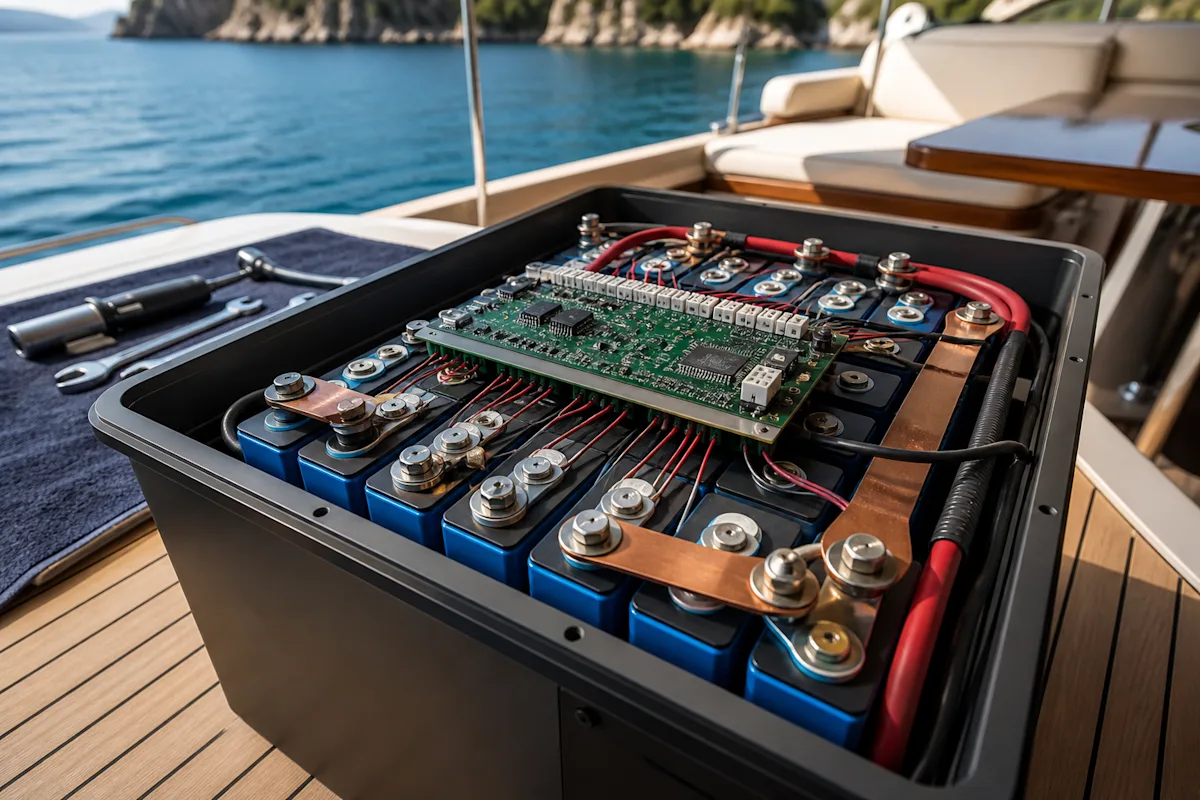
A BMS (Battery Management System) is the electronic controller inside a lithium battery: it monitors the voltage and temperature of each cell, balances the cells, and protects the battery by disconnecting it if limits are exceeded. This is exactly what makes lithium safe.
What sets lithium chemistry apart from lead-acid is how unforgiving it is: a lead-acid battery will usually forgive a mistake by slowly dying; lithium will not. The table below sets out the most common BMS behaviours.
BMS behaviour
Situation | Symptom | Cause |
|---|---|---|
Low-temperature charge lockout | Battery will not accept charge on a winter morning | A quality BMS refuses charging at low temperatures - not a fault, but protection |
Sudden cut-out | The system goes dead without warning | Protection has tripped (overload/deep discharge) |
Silent cut-out | The reason is not obvious | A BMS with no Bluetooth/alarms gives no warning |
At the point of protection, the BMS will cut the battery off abruptly; if there is only one battery on board, everything on the boat - including navigation - stops at that moment. A proper lithium installation is designed around this scenario: critical-load arrangement, alternator protection, and a BMS that gives warnings and can be monitored via an app.
For boat owners moving to lithium, the key BMS questions are: can it be monitored via an app, does it warn before cutting out, does it have low-temperature protection, and has the alternator side been properly planned? If the answer is yes to all four, you get the comfort of lithium without the risk.