What Is Cavitation?
The collapse of vapour bubbles formed by a drop in pressure around the propeller — a silent abrasive that can even eat into metal.
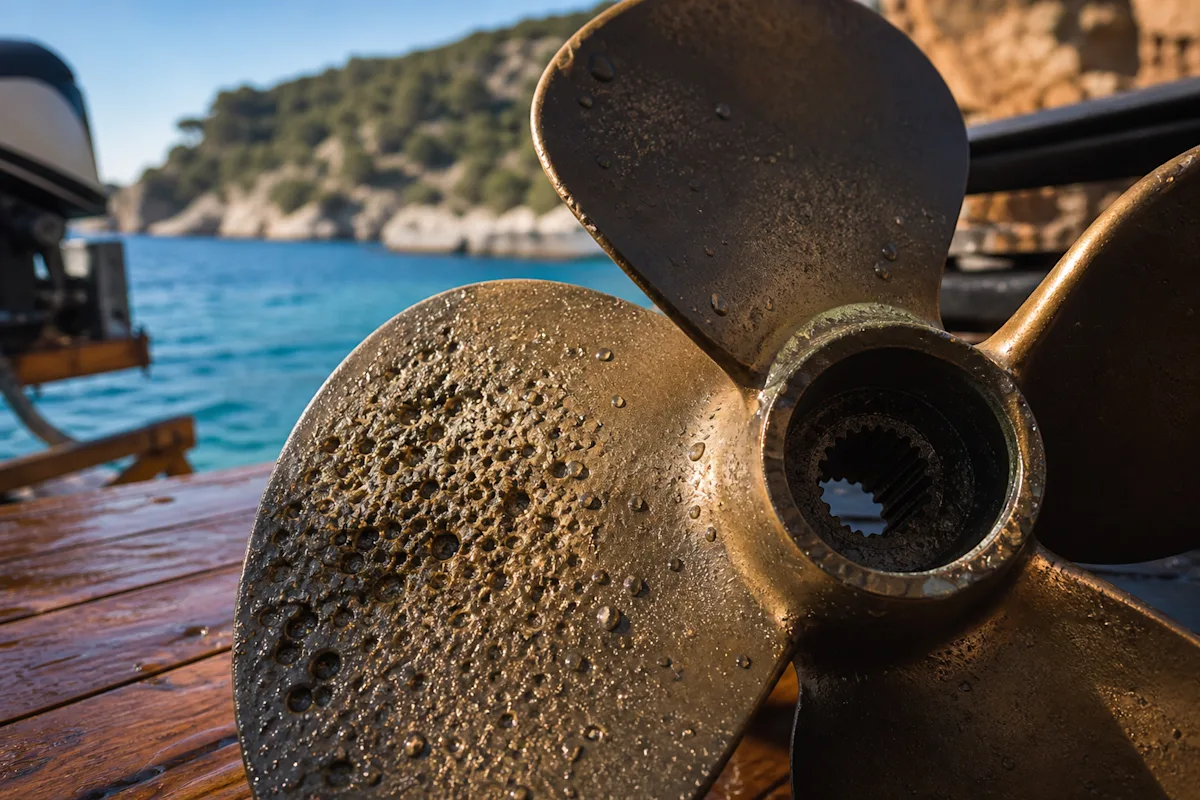
Cavitation occurs when the pressure on the suction side of a propeller blade drops suddenly, causing the water to vaporise and form bubbles, which then collapse violently in a higher-pressure area. Each collapsing bubble is a microscopic hammer blow; constant cavitation is a silent abrasive that can even eat into metal.
Persistent cavitation leaves pitting erosion on the propeller surface, reduces performance and puts strain on the shaft line through vibration. It is also a useful diagnostic sign: more often than not, it points to another issue such as a damaged blade, the wrong propeller, or a fouled hull.
Signs and causes
Sign: A whine or gravel-like noise and vibration starting at a particular rpm; at full throttle the revs rise without a matching increase in speed (though this can be confused with ventilation).
Causes: Bent or damaged blades, an unsuitable propeller choice, an overloaded boat, a fouled propeller.
The small pitted marks seen on a propeller are the hallmark of cavitation; they are not cosmetic, they are diagnostic. The cause needs to be identified along with propeller balancing and repair — whether it is selection, damage or load. That is why propeller checks are on the haul-out day checklist.