Boat Engine Won’t Start: 6 Checks Before You Touch the Starter
When the engine won’t start, the most expensive instinct is to keep hitting the starter. Three fault scenarios based on the starter sound, step-by-step diagnosis and the point at which you should stop and call for help — method instead of panic.
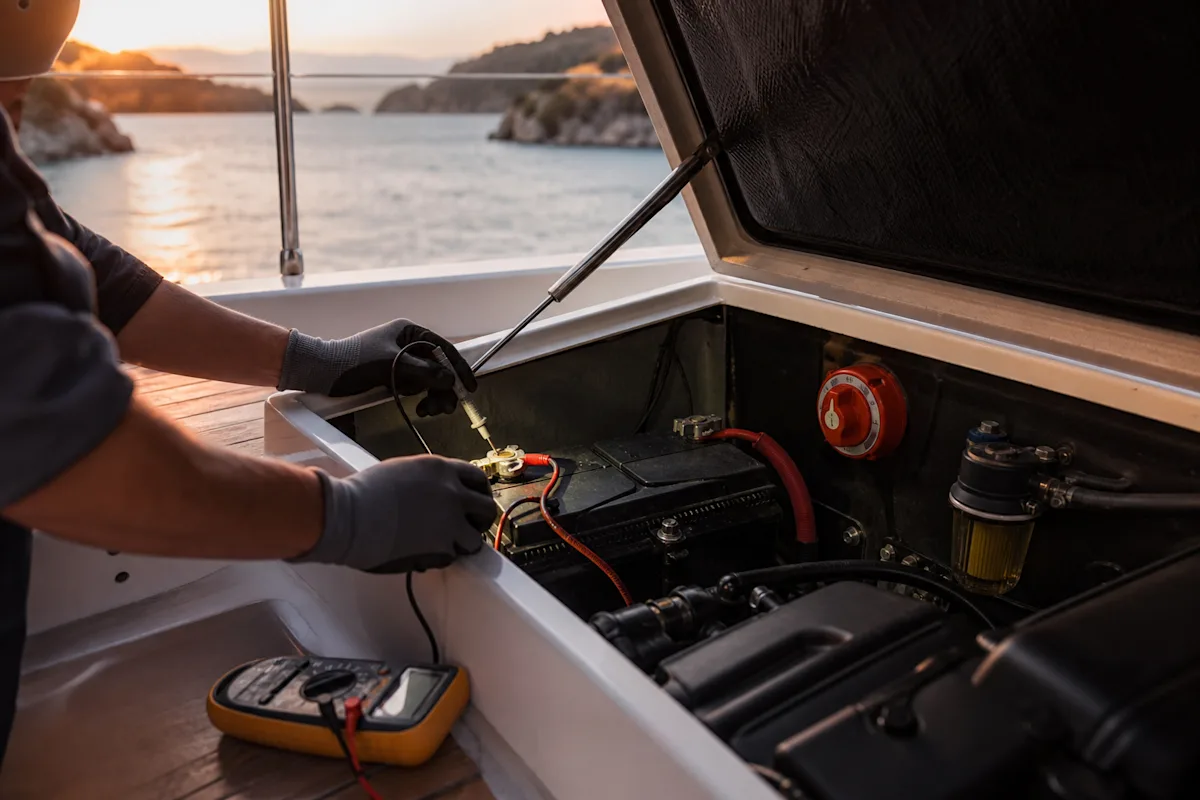
When an engine fails to start at sea, panic is the worst companion. The good news is that the vast majority of marine diesel faults come from three families — fuel, air (cooling) and electrics. If you read the symptom correctly, the fix is often a matter of half an hour.
The table below sets out the four most common symptoms, the likely cause and the first thing to check. Start by identifying the symptom clearly, then work through it in order.
Symptom - cause - first check
Symptom | Likely cause | First check |
|---|---|---|
Starter does not turn, just a single 'click' | Weak battery or high-resistance connection | Battery voltage, terminals, main switch |
Starter turns, but engine will not fire | Air in the fuel system or no fuel delivery | Primary filter, fuel valve, bleeding |
Engine runs but cuts out under load | Blocked fuel filter or diesel bug | Primary filter element, water/sludge in the bowl |
Engine runs but overheats | Insufficient cooling water | Impeller, seawater filter, exhaust water |
The first three moves at sea
Put the engine in neutral and move to a safe position (into the wind or onto anchor).
Pin down the symptom: is the starter turning, is water coming from the exhaust, is there a smell?
Start with the most likely cause from the table; repeatedly hitting the starter is not the answer, especially if there is any risk of water ingestion.
Keeping a spare impeller, fuel filter element, belt and fuse on board turns most of these incidents from 'stuck at sea' into 'half an hour late'. And the golden rule: if the engine has not started within 10-15 seconds, stop and think; repeated cranking only makes the fault worse.
Frequently asked questions
How many times is it safe to hit the starter?+
Two or three short attempts is a sensible limit; leave a pause between each one to let the starter motor cool down. Repeated long cranking does more than flatten the battery — it overheats the starter motor and increases the risk of water being drawn into diesel engines.
The battery looks charged, but the starter is weak — why?+
Open-circuit voltage only tells you state of charge, not battery health: an old or sulphated battery can collapse under load. A proper load test gives the real answer; terminal cleanliness and tightness can produce the same symptom, so rule those out first.
What is the most common problem on the first start after winter?+
In order: a main switch or intake cap left off/closed, a weak battery, and water or sludge that has settled into the fuel system over winter. All three are avoided if the winter lay-up was done properly — spring failures are usually down to winter neglect.
Is diagnosis different on petrol and diesel engines?+
The framework is the same (electrics → fuel → air); the detail is what changes: on petrol engines, ignition comes into play (spark plugs, coil), while on diesels bleeding and the stop solenoid are more prominent. The sequence in this guide is valid for the first 20 minutes on both.