Sizing a Boat Solar System: How Many Watts Do You Need?
The answer to “How many panels do I need?” is not in a brochure, but in your boat’s daily consumption. Build a load list, understand what a panel really produces (why the label can mislead), choose the right MPPT controller, and decide on the best mounting position — with a worked example.
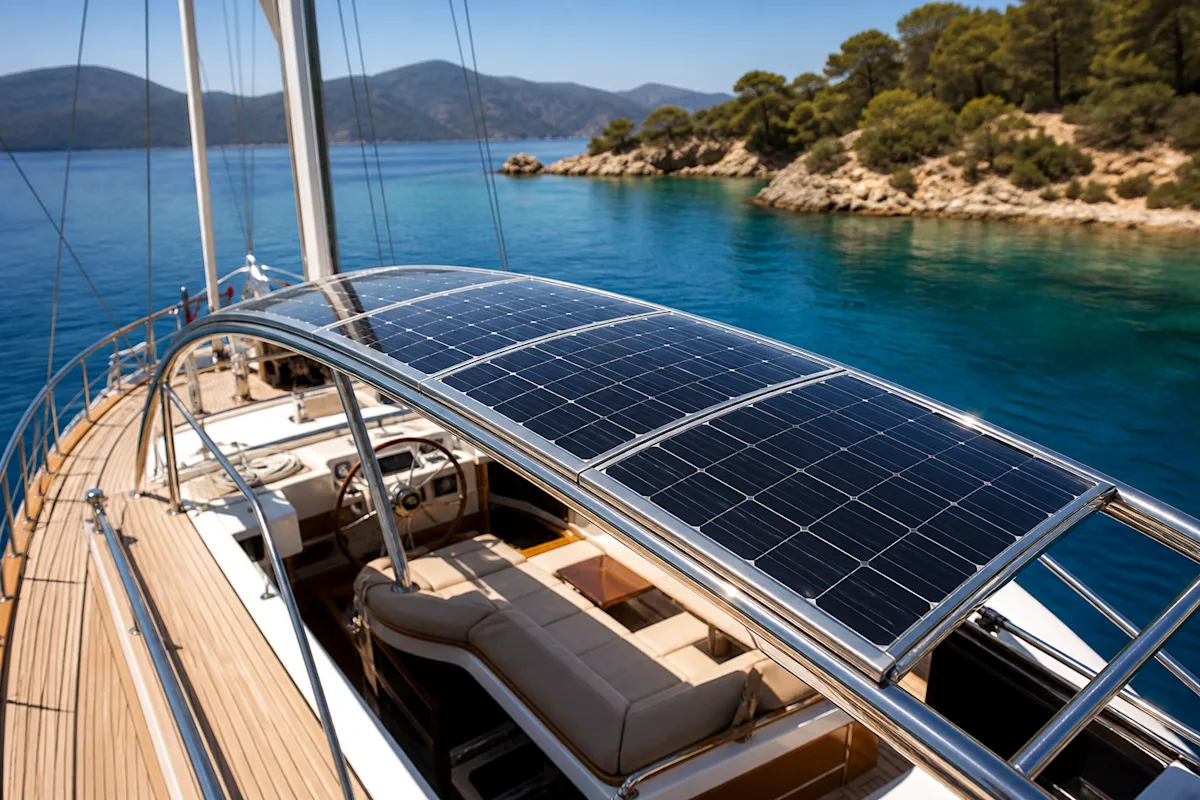
A solar panel is the quietest and most liberating power source on a boat at anchor: it burns no fuel, makes no noise, needs almost no maintenance, and produces free amps whenever the sun is out. Installed properly, it can drastically reduce your need to plug into the marina.
The system has three main parts: the panel, the charge controller, and the battery bank. The real decision is balancing your daily energy demand (amp-hours) against what the panel can produce.
Key points for the installation
MPPT controller: typically harvests roughly 15-30% more energy from the same panel than PWM; with limited deck space on a boat, that difference is often the equivalent of fitting another panel.
Panel placement: shade from a boom, bimini or arch will hurt output; MPPT is not magic — where you fit the panel still comes first.
Realistic expectations: the wattage on the brochure is for ideal conditions; cloud cover, angle and heat all reduce real-world output.
Cable size and connection quality matter as much as an expensive controller: one poor crimp or loose terminal can quietly rob the system of voltage and output. The daily amp-hours shown on the controller display are the system’s health check — have a look at it once a week.
Solar works very well alongside a wind generator: the sun does the work by day and in calm weather, while wind produces at night and in stronger conditions. For a boat that spends the summer on board and stays in quiet bays, solar is the cornerstone of energy freedom.
Frequently asked questions
Is a 100W panel enough for me?+
It depends on your consumption: a 100W panel will typically make about 25-35Ah on a summer day. It may be enough for maintenance charging and light use; with an active setup and a fridge, 200-400W is more commonly discussed. The answer is not in the panel — it is in your load list.
Flexible panel or glass panel?+
Glass (rigid) panels lead on efficiency and lifespan; flexible panels offer an advantage on curved surfaces and in weight, but they are more vulnerable to heat and ageing. The mounting position largely determines the panel type.
Does shade really matter that much?+
Yes — it is one of the most underestimated items in a solar calculation: even shade from a mast or line can reduce output disproportionately. Checking shade at different times of day before installation is more valuable than choosing the panel itself.
Will solar protect my batteries in winter?+
Yes — winter maintenance charging is one of solar’s best jobs: a small panel plus controller will offset self-discharge. For a boat laid up without shore power, it is the most practical battery safeguard.