The Real Cost of Buying a Boat Without a Survey: Three Scenarios
Saving the survey fee is often the most expensive saving in boating. Three typical scenarios, each seen time and again in the yard and on the hardstanding — hidden damp, a tired engine, and paperwork surprises — and the ‘if only I’d had it checked’ bill for each one.
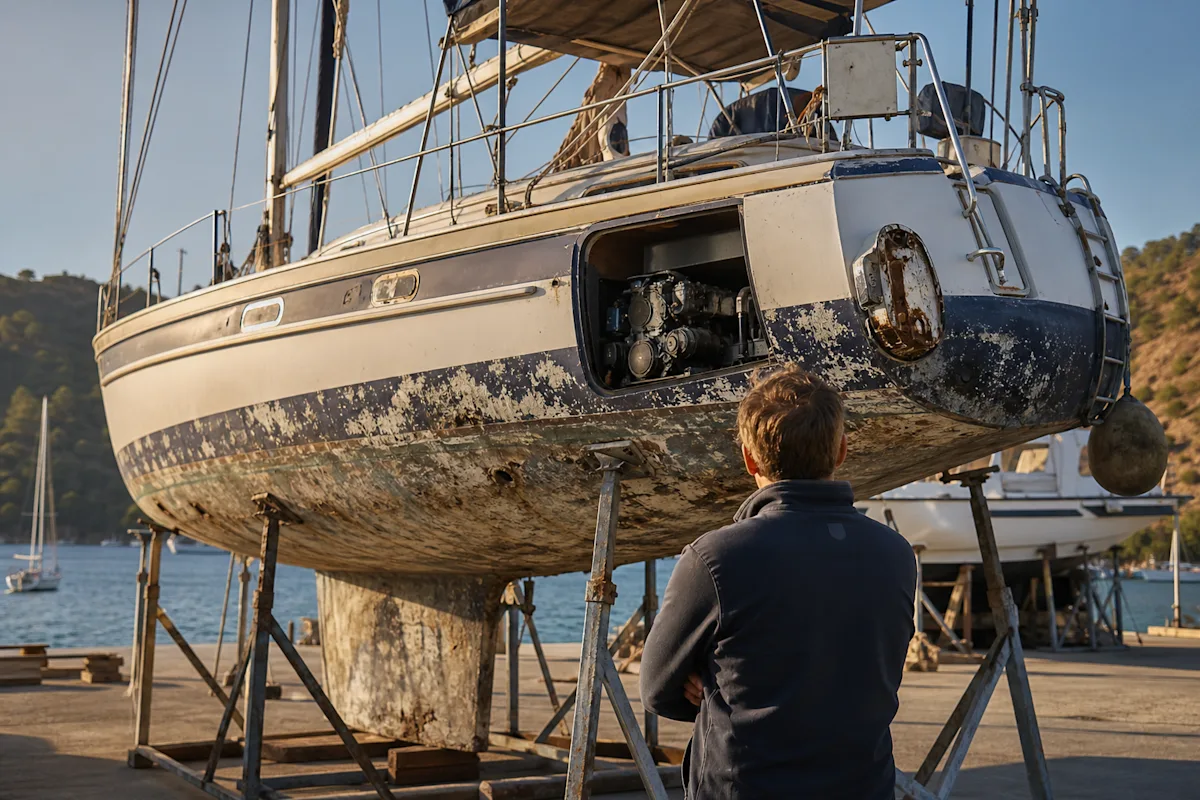
Buying a boat without a survey may look like ‘saving the survey cost’, but it is often the most expensive saving of all. The survey fee is small beside a boat’s hidden defects, and those defects only show themselves once the boat is yours.
The main risks that are not obvious to the eye, and which a survey will often pick up, are well known: osmosis and damp in a GRP hull, core decay in a sandwich deck (moisture meter), internal engine wear (compression and oil analysis), hidden cracks in rigging terminals, and a wet plywood-cored transom.
What gets missed
Structural: keel joint, bulkhead tabbing, sandwich core decay; these are the hardest and costliest repairs.
Engine: ‘starts and sounds fine’ hiding low compression and water in the oil.
Safety: an out-of-date liferaft, expired flares, LPG pipework, rigging age.
The simple maths: the survey fee is one line item, while a single missed structural defect can be ten times that. And a survey is not just about rejecting a bad boat; on a good one it gives you leverage for negotiation and a proper post-purchase work plan. Buying without a survey means agreeing to take on the boat’s hidden bill yourself.
Frequently asked questions
Are these scenarios real?+
They are representative — they do not describe any one boat or person — but each one reflects patterns seen repeatedly in the field. Boating forums and service records are full of countless versions of these three stories.
Do small/cheap boats also need a survey?+
The smaller the boat, the narrower the scope, but the principle does not change: even a few hours of compact inspection can catch the most expensive surprises (damp, engine issues, electrics). That is exactly what budget-friendly ‘mini-survey’ options are for.
Will a survey catch every problem?+
No — no inspection can guarantee to find issues in areas that cannot be opened up, or faults that are not showing themselves on the day. The promise of a survey is not prophecy; it is to measure everything that can be measured, which removes a large part of the risk from the table.
The seller says ‘I have my own survey report’ — is that enough?+
It may be useful, but it was not commissioned on your behalf: the questions were asked by the person who ordered it. As a buyer, commissioning your own independent survey is always stronger than relying on that document alone.