Switching to Lithium on Board: A Real Cost-Benefit Analysis
Lithium battery technology is technically superior — but it is not the right investment for every boat. The real cost items beyond the battery price, who it suits, the safety requirements and an honest payback calculation.
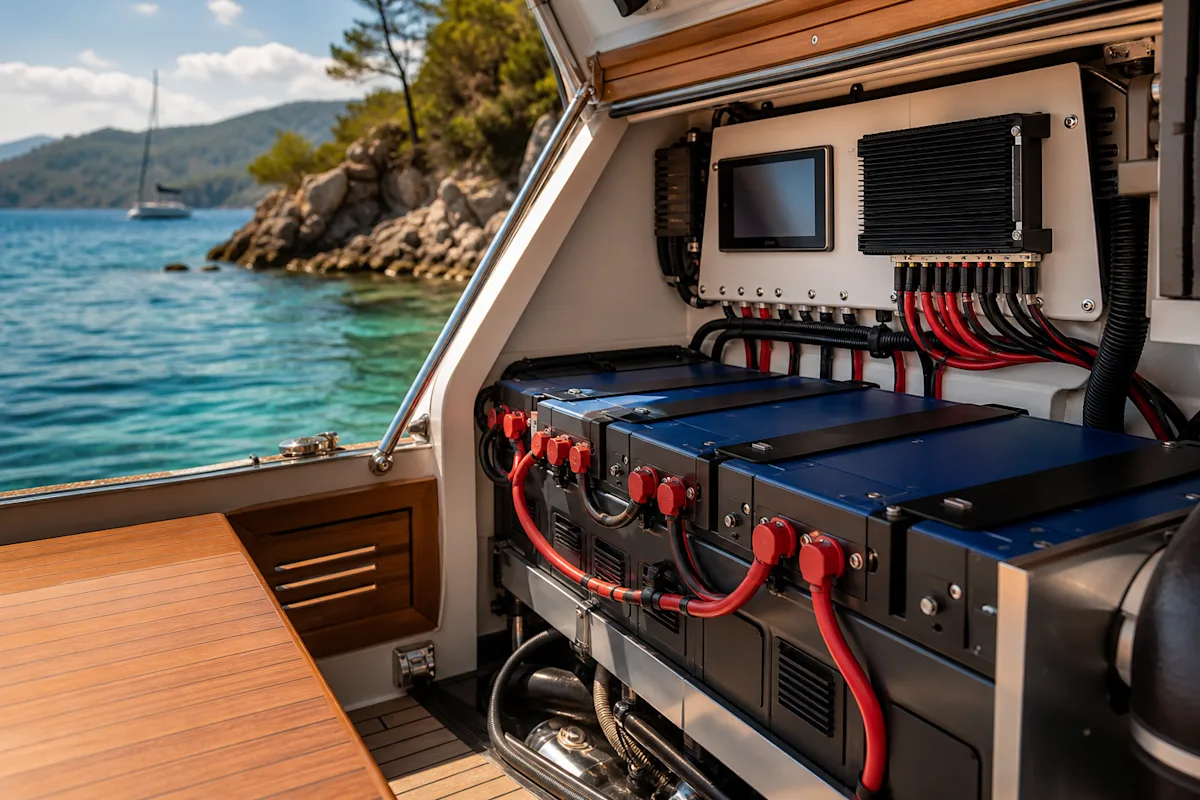
Switching to lithium looks appealing, but it is an expensive decision. The right question is not whether lithium is better, but whether it is worth it for my usage. The answer is not in the upfront price, but in the ten-year total cost and usable capacity.
The table below puts lithium (LiFePO4) side by side with an equivalent AGM bank. The most important line is usable capacity: with lead-acid, the practical limit for longevity is around 50%, whereas lithium gives you 80-90%, so almost twice the usable work from the same label.
Lithium - AGM comparison
Item | AGM | Lithium (LiFePO4) |
|---|---|---|
Upfront cost | Low | High (2-3 times) |
Usable capacity | ~50% | ~80-90% |
Life (approx. cycles) | 400-700 | 2000-5000 |
Weight | Heavy | About half |
Extra equipment | Usually not needed | DC-DC / external regulator + BMS required |
10-year total | Likely 2-3 bank replacements | Usually one bank |
The 'extra equipment' line should not be overlooked: lithium's low internal resistance can damage an alternator if connected directly. That is why the cost of a lithium system must include a DC-DC charger, a suitable BMS and cable work from the outset. Requirements discovered later are always the expensive ones.
Decision framework
For boats used hard: for those spending the season aboard and anchored out often, lithium pays back in the long run.
Weekend user: for light, infrequent use, a good AGM is often sufficient and more economical.
Weight-sensitive boat: the reduction in weight alone can justify it for performance and trim.
Frequently asked questions
Can lithium be fitted straight into an existing system?+
Most of the time, no: without alternator protection, correct charging profile compatibility and monitoring, a simple 'drop-in' swap can end in alternator failure and a safety risk. Lithium is a system project; it must be planned that way.
Is LiFePO4 safe?+
In marine use, the LiFePO4 chemistry commonly chosen is notably more stable than the chemistries used in phones; the key to safety is a quality BMS, proper fusing and correct installation. The risk is not the chemistry itself, but cheap unprotected products and a poorly planned fit-out.
How should lithium be stored over winter?+
LiFePO4 has the advantage of very low self-discharge when laid up; it should be left at partial charge (50-70%) and definitely not charged below freezing — most BMS units include low-temperature charge protection, and that is one of the things to ask about when buying.
Should the starter battery also be lithium?+
Usually not: starting is a short, high-current duty, and lead-acid is economical and entirely adequate for that job. The most sensible setup is usually a lithium domestic bank plus a lead-acid starter battery.