10 Precautions Before a Storm: A Marina Boat Preparation Checklist
Most storm damage is not written during the storm itself, but in the neglect beforehand. A 10-point preparation list for a boat alongside in the marina when a warning is issued — from warping lines to covers, bilge and post-storm checks.
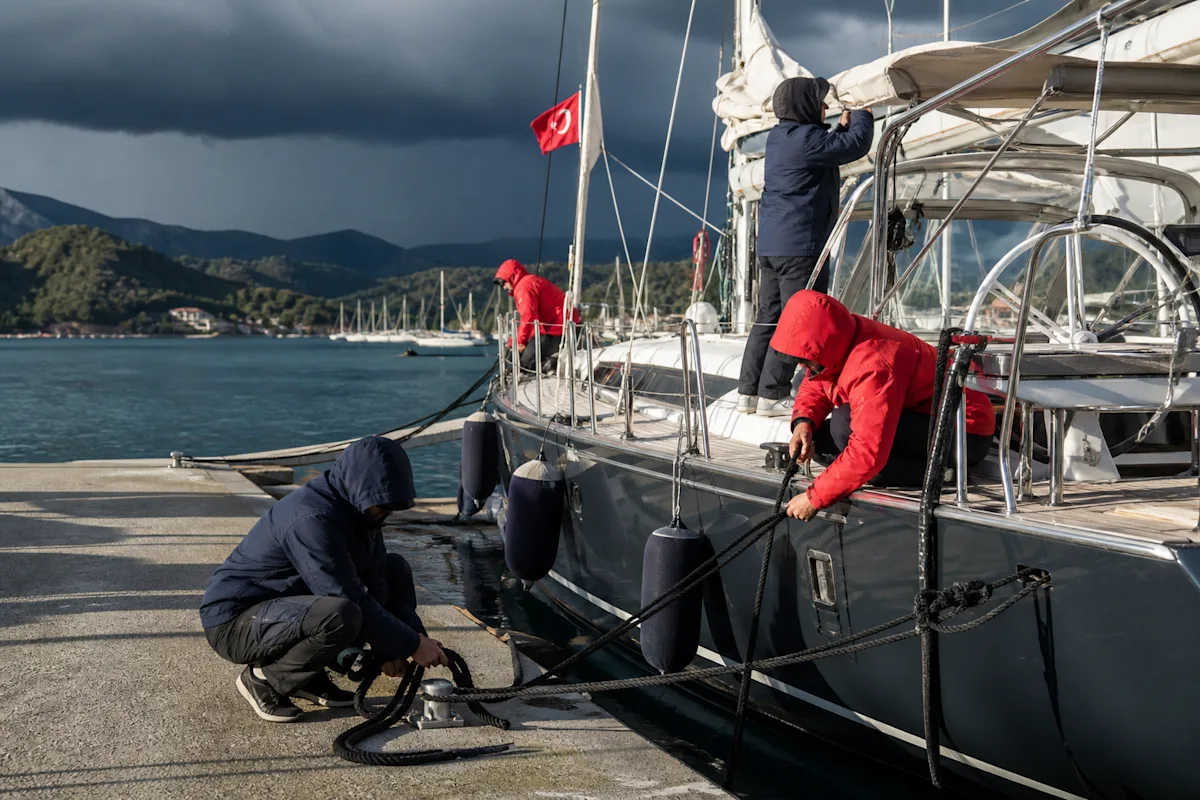
A storm warning is the moment a moored boat needs the most attention, and most of that work is done not in advance but in a one-hour walk round when the warning comes in. In a Göcek winter these warnings often arrive with a lodos, that is, a south-westerly; berths open to the south are the first to be left.
The table below sets out the storm preparation checklist.
Storm preparation checklist
Preparation | What |
|---|---|
Double up the lines | Add a second line in separate positions at critical points |
Add a spring line | Locks the boat along the pontoon and cuts the load on the other lines in half |
Fender check | Increase the number, set the heights to suit the contact points, check inflation pressure |
Remove the awning and bimini | Reduce windage and prevent tearing away |
Chafe protection | Line protection at the pilings, grating and cleat edges |
Deck gear | Anything that can fly loose must be lashed down or brought inside |
What usually parts a line is not a straight pull, but chafe on a sharp edge and old fibres giving way under a sudden load. That is why the heart of storm preparation is the lines and the chafe points.
Care storm watch threshold (Open-Meteo, 22 and 34 knot) is made for exactly these scenarios: when a warning comes in and the owner cannot be at the boat, the mooring arrangement should already be set up and checked.
Frequently asked questions
At how many knots should I take precautions?+
There is no single threshold; it depends on the boat’s length, mooring arrangement and the direction of the wind. As a practical rule, once the forecast is edging towards strong conditions (around the 7 Beaufort band), the checklist should be carried out — better to prepare early than too late.
What is the most common storm damage?+
Chafe-related line failures and the knock-on damage from the boat moving against the hull-side and guardrails; after that come losses from awnings and biminis not properly stowed. Both are largely preventable with 15 minutes’ preparation before the blow.
Should I go to the boat during a storm?+
Being on the pontoon during a storm is dangerous — preparation is done before the weather hits, not during it. If you have missed the warning, your own safety always comes before the boat.
What should I check after the storm?+
In order: the lines and contact points, any marks where the hull has touched the guardrails, the condition of the deck and covers, bilge level and pump history, and any water ingress inside. Findings should be photographed — dated photo evidence is the strongest record for any insurance claim.