Teak Caulking Process: Re-Sealing the Seams Step by Step
Open seams are the most insidious teak-deck fault: a hairline crack on the surface can mean water getting down into the plywood below. Here’s what caulking is, how to spot seam failure, and the full renewal process from removal and masking through sealant, curing and sanding.
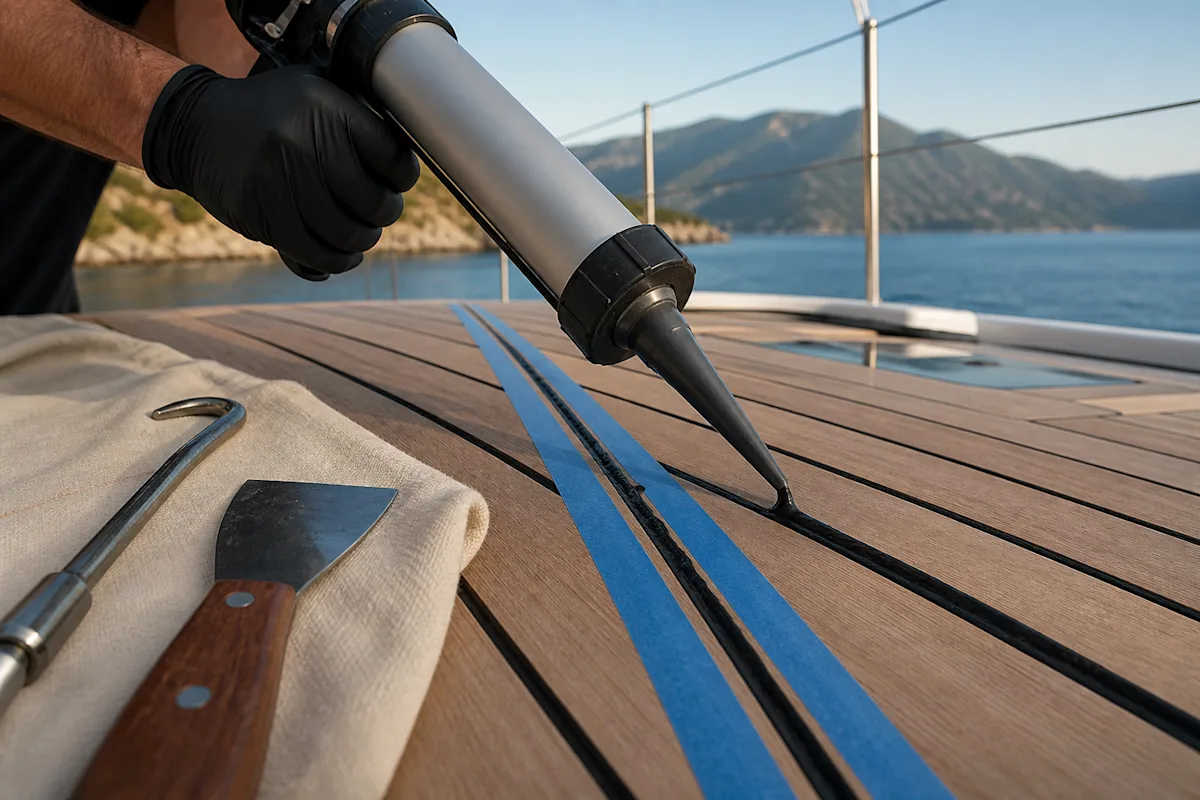
Caulking is the job of sealing the seams between planks on a wooden boat: oakum and filler are packed into the gaps to make them watertight. It is one of the most fundamental, and most skilled, maintenance tasks on any wooden vessel.
Wood is a living material: it dries, opens, takes up moisture and swells. Caulking manages that movement so the boat stays dry; if it is neglected, the seams open up and the deck and topsides begin to leak.
What you need to know
Open seams: dry timber opens up between the planks, which is the classic cause of leaks in the deck and topsides.
A skilled job: wrong sealant or over-packing will damage the timber; it takes proper craftsmanship.
Ongoing upkeep: a wooden boat does not want 'once a season' attention — it needs regular small interventions.
Modern synthetic sealants (polyurethane-based) have partly replaced traditional oakum, but the principle is the same: keep water out while allowing the wood to breathe and move. For a gulet or tirhandil owner, the caulker is as important as any master shipwright on board.
Frequently asked questions
How long does caulking take?+
It depends on the scope: a small local repair may take a few days; a full deck renewal, allowing for curing, usually needs a one- to two-week window. A large part of that time is simply allowing the sealant to cure properly — rush the job and you’ll be back to it sooner than you should be.
The seam has opened but I can’t see water inside — can it wait?+
By the time water shows, the issue has already travelled. Water entering through an open seam can move under the teak and collect in the plywood below. 'There’s no damp inside' can be misleading — once opening is found, dealing with it within a sensible timeframe is the cheapest option.
Does the sealant brand matter?+
Yes, there are quality differences between marine sealants formulated for teak (polyurethane/MS-based). But the reality on the job is this: workmanship — removal, cleaning, masking — matters more than the badge on the tube. Good product plus poor preparation still gives a poor result.
Won’t sanding after caulking make the deck thinner?+
Fairing sanding should be light and controlled; the aim is to remove excess sealant, not to wear away the teak. Even so, this stage must be done carefully — where deck thickness is critical, the sanding plan should be agreed from the outset.