What Is Fuel Consumption Calculation?
The real maths of a boat’s fuel use — once you start thinking in miles rather than hours, consumption and range become much clearer.
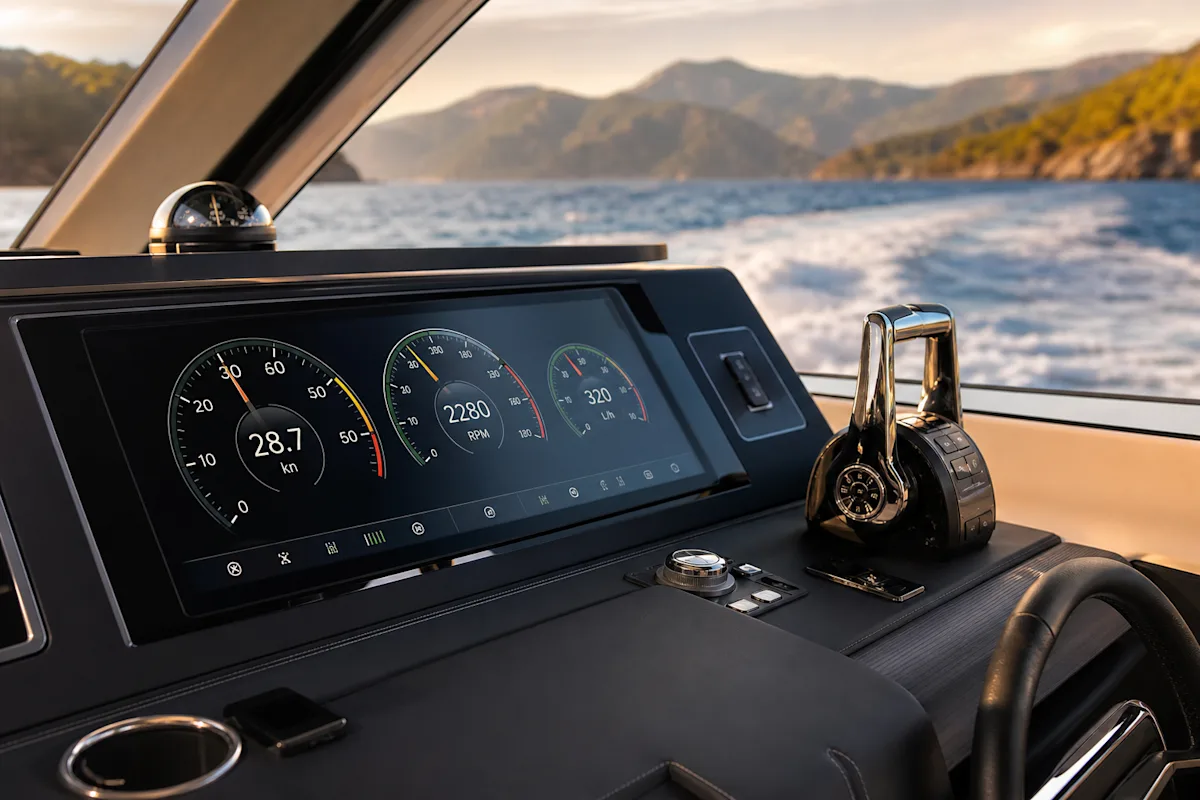
The most common mistake in boat fuel calculations is to think in litres per hour. In reality, what affects your wallet and your range is litres per mile. A boat may burn 20 litres an hour, but how many miles it covers in that hour changes everything.
The formula is simple: litres per hour divided by speed in knots gives litres per mile. The table below shows how the same 20 litres an hour can turn into a very different cost per mile at different speeds.
How litres per hour turns into litres per mile
Consumption | Speed | Litres per mile | Comment |
|---|---|---|---|
20 L/hr | 5 kn | 4.0 L/mile | Slow and costly zone |
20 L/hr | 8 kn | 2.5 L/mile | More efficient |
20 L/hr | 10 kn | 2.0 L/mile | Same burn, half the cost |
As you can see, the 'most economical revs' and 'economic cruising' are not the same thing. On a planing boat, just below the threshold of getting on the plane is usually the most expensive zone; on a displacement boat, forcing the hull speed just wastes fuel.
Range and safety
The one-third rule: one third for the outward leg, one third for the return, and one third in reserve; especially on routes where the weather may turn.
Usable fuel: not every litre in the tank can be used; you need to allow for sediment at the bottom and a safety margin.
A fouled hull: if litres per mile rise at the same revs, it is often a sign of a fouled hull rather than an engine issue.
A simple logbook solves a lot: at every fill-up, note the litres added, engine hours and roughly the miles covered. After three months you will have your boat’s true litres-per-mile curve; that curve is a mirror for both your wallet and fault-finding.