What Is a Gas and CO Alarm?
Sensors that pick up LPG leaks and carbon monoxide before anyone notices - if the battery and service life aren’t tracked, they’re just plastic boxes.
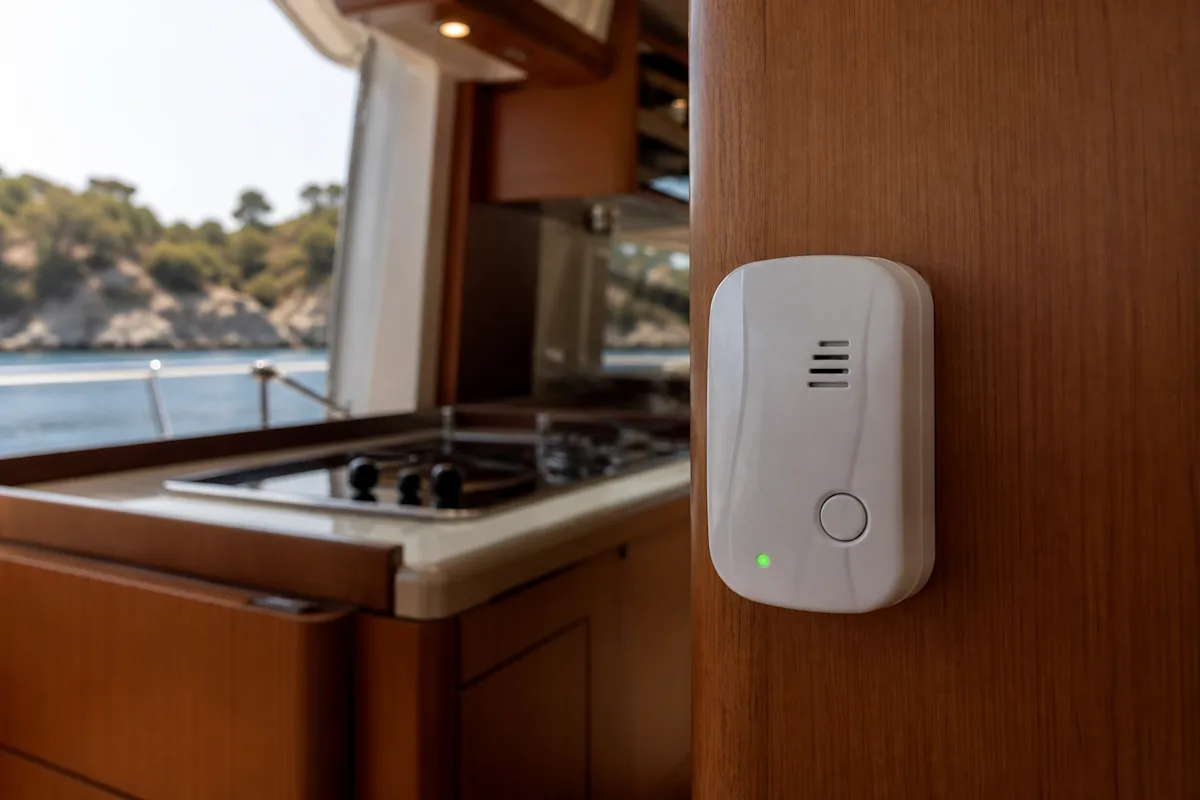
A boat has two separate watchmen: the LPG detector is fitted low down (bilge, near the cooker) to catch heavier-than-air cylinder gas; the CO alarm is positioned in the living area, close to bunk level, for colourless, odourless carbon monoxide. They are different devices, and one cannot do the other’s job.
CO is the most insidious risk on board: the source may not be your own engine; exhaust from the neighbouring boat with its generator running can drift in through an open hatch and into your cabin. On the LPG side, the detector is the 24/7 version of a soap test.
Common weak points and the rule
Expired sensor:the unit light comes on, but the sensor is dead (typical life 5-7 years); the manufacture/replacement date should be written on the unit and tracked on a calendar.
Wrong position:an LPG detector fitted on the deckhead, or a CO alarm fitted in the bilge, is reading the physics backwards.
Power cut:if it is switched off at the breaker to ‘save the battery’, the detector is blind exactly when it should be protecting you.
The three rules: correct height, uninterrupted power supply, and calendar-based sensor replacement. And the behaviour rule: when the alarm sounds, ventilate first and isolate the source (gas valve or engine), then investigate. The most dangerous alarm of all is the one silenced as a false alarm.