What Is Jet Propulsion?
A propeller-free system that draws in water and jets it out under pressure — kinder to shallow water and swimmer safety, and an enemy of weed.
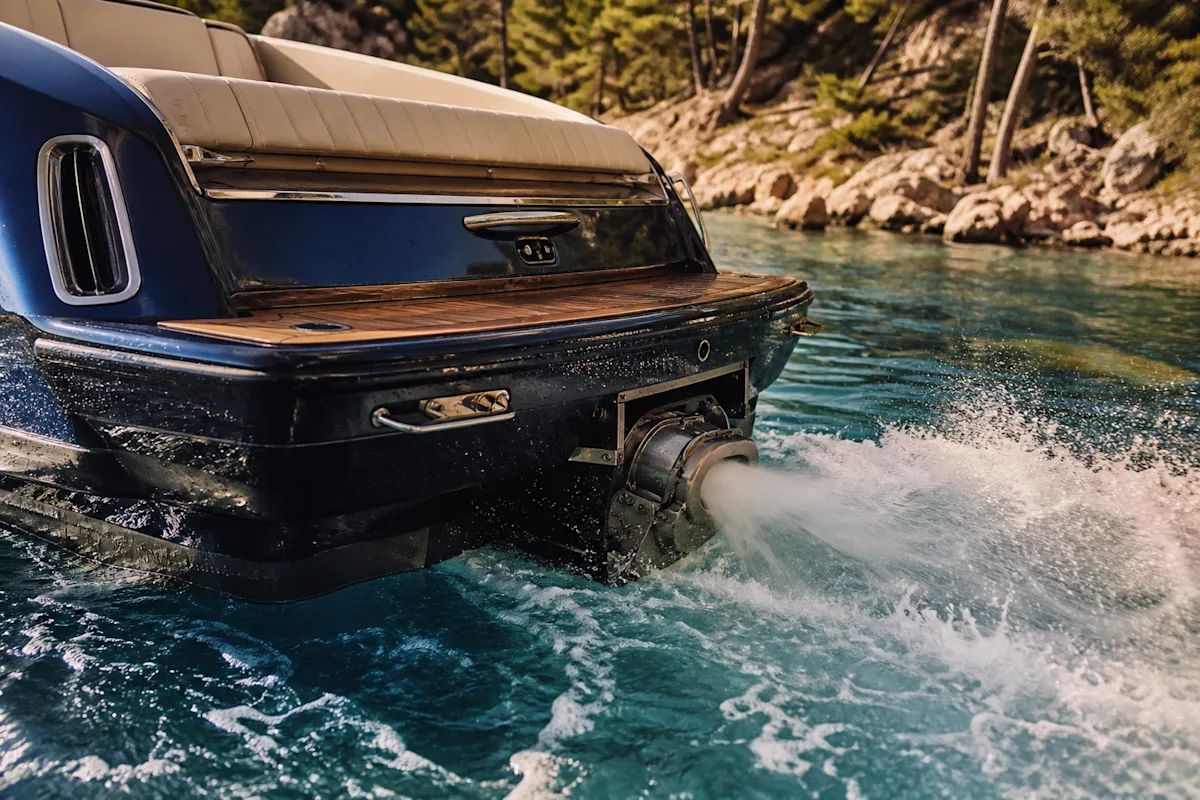
Jet propulsion works by drawing water in from under the hull, accelerating it with an internal impeller, and blasting it out through a nozzle at the stern; steering is by turning the nozzle, while reverse is achieved with a bucket that redirects the flow forward. It is the system used on jet skis and some high-speed/service boats.
The table below sets out the advantages and the trade-offs.
Jet propulsion: advantages and trade-offs
Feature | Jet propulsion | Conventional propeller |
|---|---|---|
Swimmer safety | No exposed propeller, the safest option | Exposed propeller risk |
Draught | Very shallow, can enter shallow coves | Deeper |
Low-speed manoeuvring | Weak — no throttle, no steering | More controlled |
Mid-speed efficiency | Lower than a propeller | Efficient |
The intake grille will suck in just about anything floating past — bags, weed, ropes; most systems have a reverse-flush flap for sudden loss of thrust and vibration, and its location should be known.
For lay-up, salt water is not left in the system; a freshwater flush is the most important single maintenance job for a jet system.