What Is a Heat Exchanger?
A tube bundle that cools the engine’s fresh-water circuit with seawater — the marine equivalent of a car radiator.
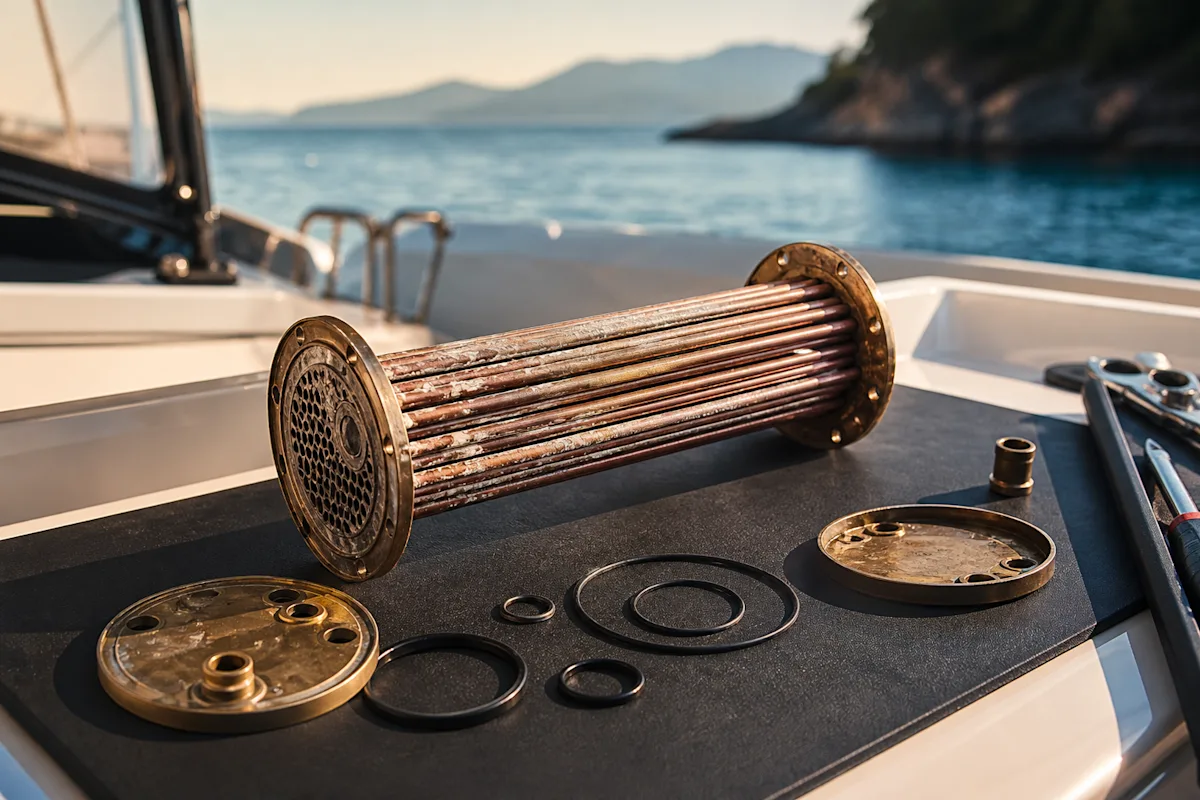
A heat exchanger is the marine engine’s radiator: it transfers heat from the closed-circuit engine coolant (antifreeze-treated fresh water) to seawater passing through fine tubes. The seawater takes away the heat and is discharged overboard with the exhaust, without ever entering the engine.
It is the heart of the cooling system: the impeller brings the water in, and the heat exchanger sheds the heat. As the tubes narrow with deposits, the engine starts to run hot for no apparent reason, especially at higher revs. There is a clear order for diagnosing overheating; the table below sets it out.
Overheating diagnosis order
Order | Check | What to look for |
|---|---|---|
1 | Impeller | Burnt, tired or missing blades |
2 | Seawater strainer | Weeds, a bag, a full basket |
3 | Heat exchanger | Scale, salt deposits, blocked tube bundle |
4 | Exhaust elbow | Restriction from soot and salt build-up |
Two routine jobs can keep a heat exchanger going for years: every time you change the impeller, open the cover and look for broken blades, and once a year renew the pencil anode inside it. If the pencil anode is not being replaced, the tube bundle is rotting away.
The symptom is typical: a motor that runs normally at idle but overheats under load is often pointing to a restricted heat exchanger. Regular acid descaling and brushing keep the tube bundle clear.