What Is an Alternator?
An engine-driven generator that charges the batteries while motoring - the boat’s only power station underway.
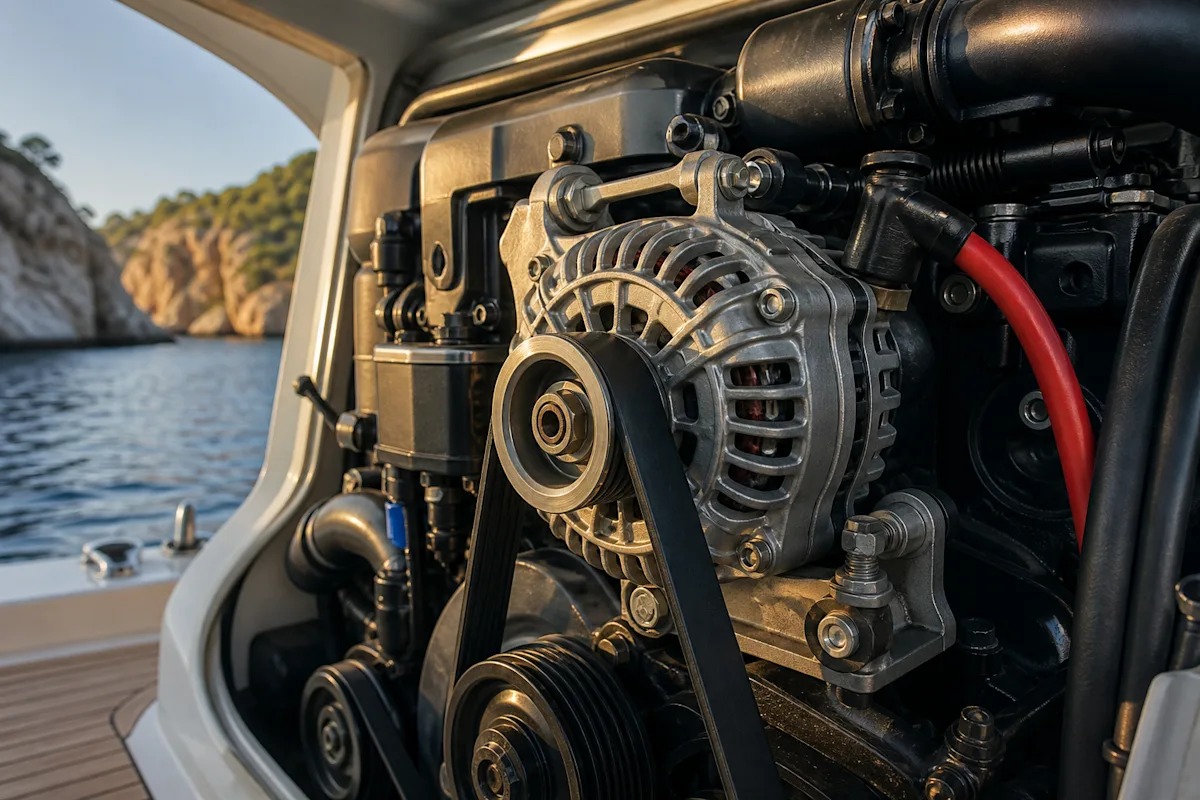
The alternator is the engine-driven electrical generator: when underway it charges the batteries and covers the boat’s immediate loads. Every hour away from the marina, your power budget rests with the alternator.
To judge its health, the gauge is straightforward. The table below shows what you should see while underway.
Charge indicator
Condition | Healthy | Warning sign |
|---|---|---|
Voltage with engine running (12V system) | ~14 V | If you are seeing 12.5 V, the alternator is effectively on holiday |
24V system | ~28 V | 26 V or less is insufficient |
Belt | Taut, clean | Black dust, squealing noise |
A crucial detail: standard built-in regulators work on automotive logic, and once the battery is partly charged they cut the current back too early. A large deep-discharged service bank will never be fully charged by a short engine run; that is the physics behind the 'I ran the engine for an hour and it’s dead again' complaint.
When moving to a lithium bank, alternator control (DC-DC or an external regulator) is not up for negotiation, it is essential; a directly connected lithium bank can burn out the alternator.