What Is the Battery Master Switch?
A rotary switch that cuts the boat’s battery connection in one move — both a safety isolator and, if used wrongly, an alternator killer.
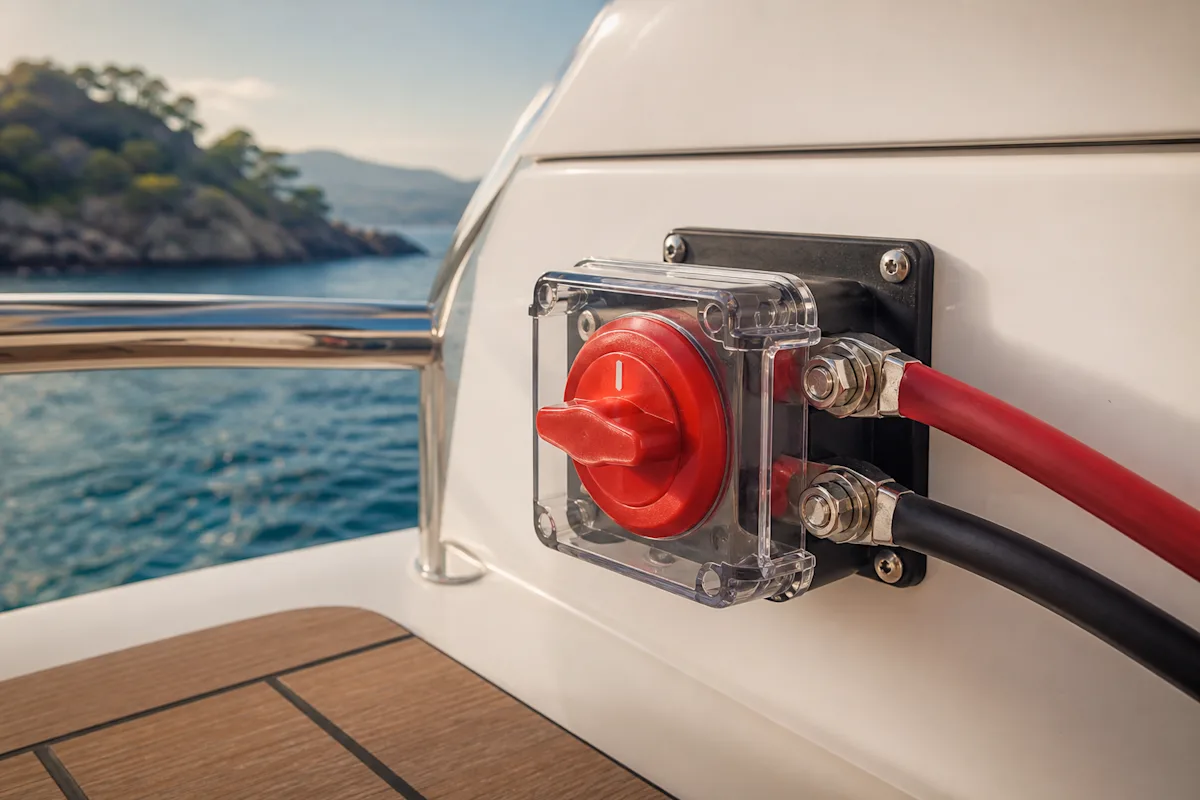
The battery master switch is the main isolator that disconnects the battery banks from the boat’s circuits. It has two vital jobs: to properly shut the systems down when leaving the boat, and to kill all power in one move in an emergency (cable fire, leakage). Everyone on board should know where it is.
The classic 1-2-BOTH-OFF switch lets you choose which bank is on line. The table below shows the positions.
1-2-BOTH-OFF positions
Position | What it does | Note |
|---|---|---|
1 | Only bank 1 on line | Usually starting or service |
2 | Only bank 2 on line | Other bank |
BOTH | Both banks linked | If left like this, domestic loads can drain the start battery too |
OFF | All isolated | Never turn to OFF while the engine is running: alternator diodes can blow |
The most expensive mistake is turning to OFF while the engine is running: cutting the circuit under load can burn out the alternator diodes. The second classic mistake is leaving it on BOTH; overnight domestic loads will flatten the start battery too, and the engine won’t crank in the morning.
Two habits are enough: switch the battery master off when you leave the boat (make sure the automatic bilge circuit is wired to be supplied independently of the switch, and have it checked), and never touch the switch while the engine is running.