Cut and polish: shine is really about protection
Shine isn't just cosmetic: oxidised gelcoat turns porous, holds dirt and salt, and goes flatter faster every year. The right polishing breaks that cycle - but with one honest caveat: every pass of cutting compound takes microns off the gelcoat. That's why the Care approach is measured: the surface is assessed first, the lightest step that's needed is applied, and it's sealed over with protection.

Scope
Oxidation removal
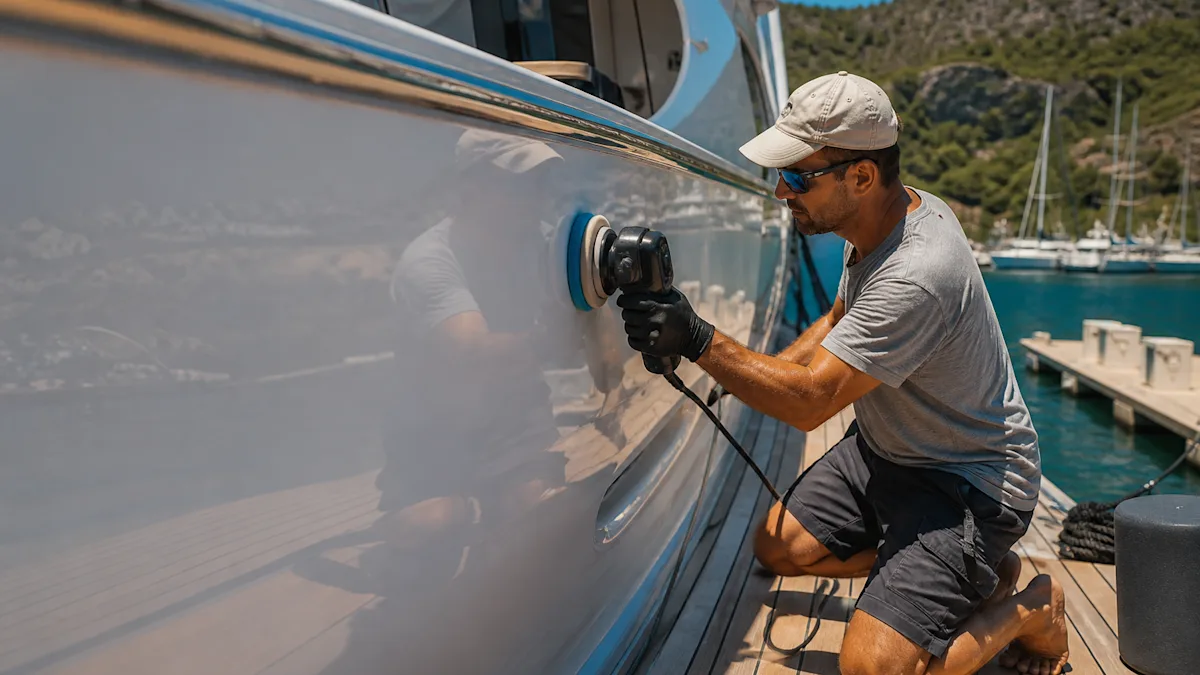
Staged cutting compound on a dulled surface
Polishing & protection
A wax/sealant layer after fine polishing - the insurance on your shine
Scumline cleaning
Safe removal of the exhaust staining (scumline) on the transom and topsides
Stainless polishing
Polishing and protecting guardrails and deck metalwork
Ceramic coating
Long-life protection on suitable surfaces - on a cost/benefit basis
Season plan
A mid-season refresh and washing routine - it extends the life of the shine
Brands we work with
What do we use for cutting and polishing?
In polishing, the order of abrasives matters as much as the machine: skip a grade on the way from cutting compound to fine polish and you leave holograms in the surface.
3M
We apply itThe family we use across compounds, pads and abrasives. Gelcoat has a limited thickness, so we use the coarsest grade only as far as needed and no further.
Gelcoat gets thinner with every polish; which grade was applied is written into your job file.
How it works
Surface assessment
The degree of oxidation and the state of the gelcoat are recorded; which area needs which step is written down.
Staged quote
The lightest step that's needed sets the baseline: a single-stage polish and a two-stage compound-plus-protection are priced separately.
Application and protection
The application is photographed; the protective layer and the recommended care routine are logged to your file.
See the proof
Example job: 15-year-old gelcoat - from flat to a mirror
Two-stage compound + a protective layer; the scumline on the transom was cleaned off with a safe chemistry. A mid-season refresh was planned. (Real before/after frames will be added at launch.)
FAQ
How many times a year should a cut and polish be done?+
A full cut is NOT an every-year job - it isn't done unless it's needed, because every pass thins the gelcoat. A healthy routine: a light polish + protection once a year, a mid-season refresh; a full cut only when oxidation has set in.
Is it done by machine or by hand?+
By machine - with the right pad at the right speed. Wrong machine work leaves holograms and burns; that's why the application is photographed and worked area by area.
Is a ceramic coating worth it?+
On a properly prepared surface it gives 2-3 seasons of protection and makes washing easier; but applied over oxidised gelcoat, you've simply sealed your money in. First a surface assessment, then a cost/benefit table - the decision is yours.
Why does scumline form, and can it be prevented?+
Exhaust soot and sea minerals work their way into the pores of the gelcoat. Regular washing and a protective layer slow it down; in cleaning, an acidic chemistry has to be used at the right strength on the right surface - misused, it burns the gelcoat.
Does compound damage the gelcoat?+
It's abrasive - that's exactly why it works. The damage starts with needless, frequent application. Our principle is clear: the lightest step that's needed, only as much as needed; if it isn't needed, we say 'a polish will do this year'.
On this topic: guides & glossary
For those wondering about the terms: the guide and glossary entries below explain this service in depth.



Let us see your boat on site
Start with a free introductory check; both the quote and the decision in writing.
⭐ Google 4.9 · 82 reviewsTÜRSAB memberSame-day for emergencies
Takes 30 seconds